


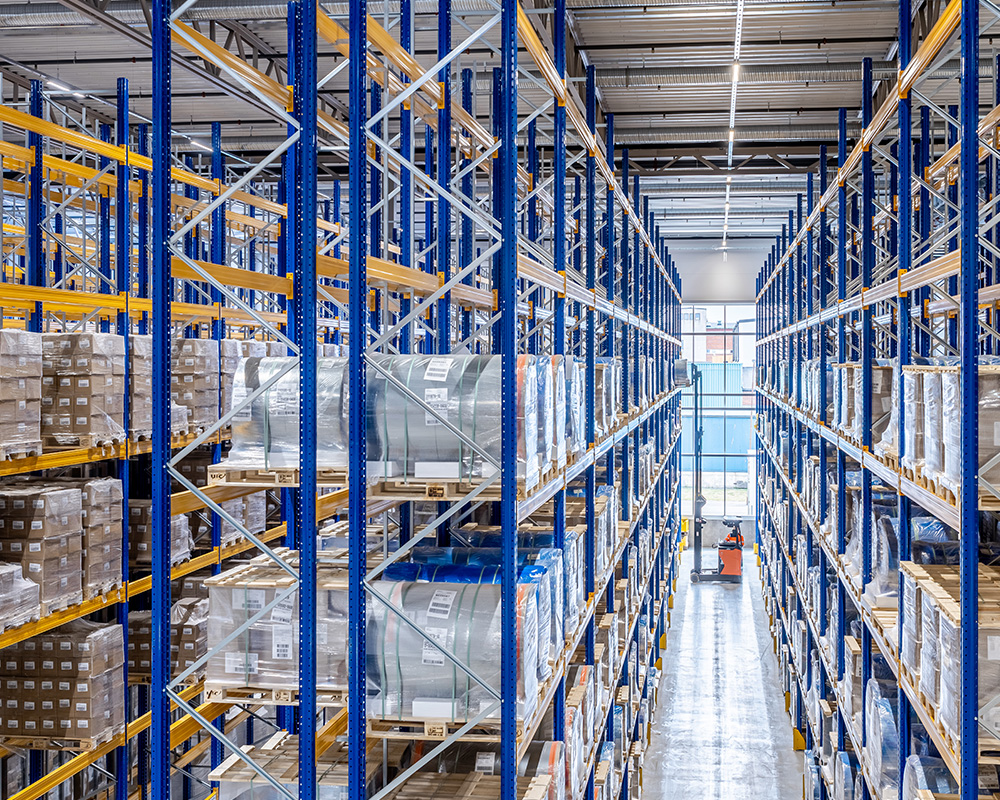
The warehouse may not be the first thing that comes to mind when you’re assessing your company’s carbon footprint. But it should be. Energy consumption, packaging, internal transport, and poorly optimized picking routes all contribute to a significant environmental impact. Here are five concrete methods weGP Lastuse to make warehouse management more environmentally friendly—and that you can require from your logistics partner.
1. Energy-efficient lighting and operations
Warehouse lighting often accounts for 30–40 percent of energy consumption in a warehouse facility. Switching to motion-activated LED lighting provides immediate and measurable results. At facilities where solar panels can be installed, using renewable electricity on-site can further reduce the carbon footprint. Energy labeling and ongoing monitoring of consumption per unit handled make it possible to identify efficiency improvements over time.
2. Minimizing and optimizing packaging
Unnecessary packaging is one of the most significant environmental issues in logistics. Companies striving for eco-friendly logistics should review the entire packaging chain:– Adjust box size to match actual product size– Choose renewable or recyclable protective materials– Eliminate foam wherever possible without compromising product integrity– Use return logistics to reuse packaging materials Minimized packaging also means fewer pallets per shipment, which reduces the number of transports.
3. Optimized picking & packing and warehouse layout
Inefficient picking routes in the warehouse generate unnecessary movement, waste working time, and increase the use of internal transport equipment such as forklifts and order pickers. A well-planned warehouse layout based on ABC analysis—where high-frequency products are placed near the shipping areas—reduces total movement time and energy consumption per order.
4. Structured returns management
Returns are one of the fastest-growing environmental issues in e-commerce. A structured returns process that enables sorting, repackaging, and reuse reduces waste and keeps products in circulation longer. This is circular logistics in practice.GP Last We handle returns as an integrated part of the 3PL setup. Read more about how it works in practice under:
5. Digital Management of Goods Flows
Digital warehouse management systems (WMS) enable real-time distribution of inventory information, automatic reorder point control, and the elimination of excess inventory. Excess inventory ties up capital and resources and often leads to write-offs. Precise control of incoming and outgoing goods flows is therefore both a sustainability and a cost-saving measure.
Summary
Environmentally friendly warehouse management is not about a single decision but rather a systematic process where every part of the flow is translated into measurable goals and follow-up. When logistics partners and customers share the same level of ambition, results are achieved more quickly.GP Last We offer solutions that combine environmental initiatives with operational efficiency. Learn more about how we work with